[Blockchain A to Z] Solving Traders’ Challenges with RisingX
By The VOB Foundation
This post introduces how RisingX functions as an AI-driven trading assistant that removes emotional bias by guiding traders through coin selection, entry timing, profit-taking, and risk management using clear data-based signals. By following simple rules—long on L signals and short on S signals—traders can make more disciplined decisions, protect capital, and avoid common psychological traps in volatile crypto markets.
Introduction: Few Things Are More Anxious Than Being Lost
Almost everyone has experienced it at least once: missing the correct highway exit during a family trip.
“Left or right?” “How long until we arrive?” When no one has a clear answer, anxiety and confusion grow quickly.
What is most frightening is the panic that comes from realizing you may have taken the wrong path.
Today, things are different. Navigation systems guide us in real time with direction, speed, distance,
and arrival time. Even if we take a wrong turn, the system recalculates calmly and responds accurately.
That is why we no longer need to feel anxious on the road.
Investing is not very different. Faced with countless possible paths, humans hesitate, fear, regret,
and often react too late. AI, however, has no emotions. It relies only on data and probability,
and acts accordingly.
What if your investments had such an assistant—one that makes decisions, shows direction,
and responds calmly during crises?
In investing, RisingX removes unnecessary emotional interference for beginners
and helps shorten decision-making time.
1. Which Coin Should You Choose?
Choosing what to buy is the first decision that determines success or failure in crypto trading.
With countless assets available, selection requires clear criteria—not vague intuition,
but strategies based on data and structure.
1) Finding Coins That Move with Bitcoin
Among all cryptocurrencies, Bitcoin remains the market leader.
In terms of market capitalization, trading volume, and dominance,
it overwhelmingly influences the overall market.
Most altcoins follow Bitcoin’s direction.
When Bitcoin is trending upward, choosing coins moving in the same direction
increases the probability of riding the trend.
Conversely, buying against Bitcoin during a downtrend is highly risky.
Tip: Use the RisingX Meta Chart to check whether Bitcoin signals
align with signals from candidate assets.
2) Beginners Should Focus on Major Coins
One common mistake beginners make is jumping directly into highly volatile altcoins.
While volatility offers opportunity for experienced traders,
it represents significant risk for newcomers.
Beginners should prioritize major coins such as Bitcoin, Ethereum, and Ripple.
These assets tend to have more stable volatility,
and technical indicators and chart patterns behave more reliably.
3) Choose Coins with Clear Trends
Avoid assets stuck in unclear sideways movement.
Instead, focus on coins with clearly defined trends.
On the RisingX Meta Chart, a “clear trend” is identified
when most of the following conditions appear simultaneously:
L signal appears
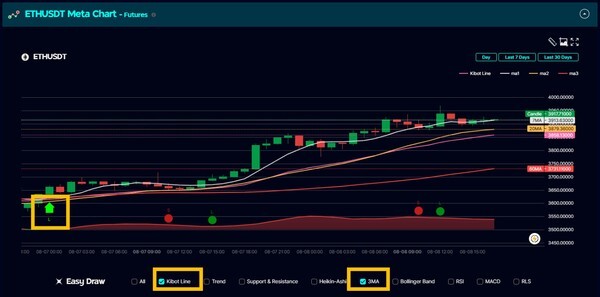
Kivot Line (pink) slopes upward at 45 degrees or more
7-day, 20-day, and 60-day moving averages are aligned in order
RSI L signal appears in the same timeframe
When all four conditions are met, the asset has a high probability
of continuing a short- to mid-term uptrend.
Reversed conditions indicate a strong downtrend.
2. When Should You Enter?
After selecting a coin, the next step is determining entry timing.
Even the best asset can produce poor results if entered at the wrong moment.
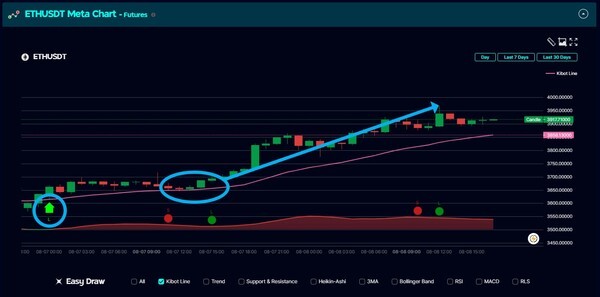
The Kivot Line on the RisingX Meta Chart provides a simple and intuitive guide.
1) When the Candle Is Near the Kivot Line
The ideal entry zone is when price candles are near the Kivot Line,
which acts as the market’s equilibrium axis.
Prices tend to return to this central point after directional moves,
making it an optimal entry reference.
2) When the Candle Is Far from the Kivot Line
If price is far from the Kivot Line, avoid rushing in.
Instead, consider these alternative criteria:
Enter near the 7-day moving average, which often acts as short-term support
Define an entry zone by grouping multiple small candles into one compressed range
Use the midpoint or wick of a long candle as a retracement entry area
Tip: Entry timing is not about “buying cheap and selling high,”
but about identifying where market energy is likely to return.
The Kivot Line clearly visualizes this zone.
3. When Should You Take Profit?
Deciding when to sell is one of the hardest parts of trading.
Many beginners give back profits due to greed.
Successful investing prioritizes capital preservation over short-term gains.
1) When the Signal Reverses
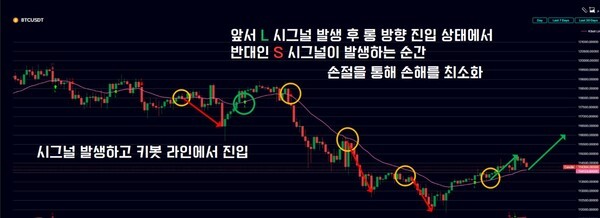
If you entered on an L or S signal, the appearance of the opposite signal
can be used as a mechanical profit-taking point,
reducing emotional decision-making.
2) Using Support and Resistance
Set targets based on support and resistance levels.
Strong spacing between short-term moving averages
often indicates sustained momentum toward resistance zones.
3) Using the RLS Feature
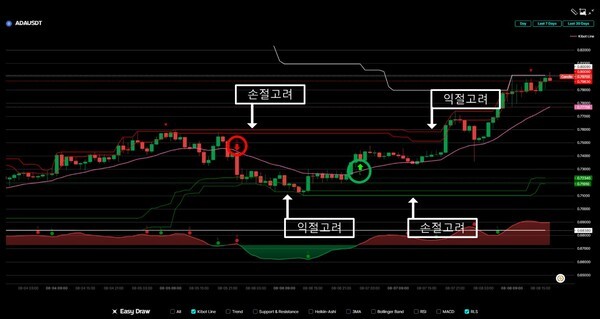
In an L signal, the red upward line indicates take-profit levels.
In an S signal, the green downward line serves the same role.
4. When Should You Cut Losses?
Stop-loss is a safety mechanism that prevents small mistakes
from becoming catastrophic losses.
Loss limits must be defined in advance.
Use support and resistance levels as stop-loss references:
break below support for long positions,
or break above resistance for short positions.
5. Will the Trend Continue?
Trends sometimes extend further than expected.
To avoid missing continuation moves,
signals must be checked alongside external factors.
Confirm that trend conditions remain valid on the Meta Chart
Monitor macro events such as CPI, PPI, and interest-rate announcements
Watch for Bitcoin volatility alerts and rocket signals
During sudden volatility, entering near candle midpoints
is generally more stable than chasing market orders.
6. Risk Management Checklist
Avoid high leverage; keep it under 3×
Always set take-profit and stop-loss before entering
Beginners should use small positions or simulated trading
Follow signals consistently; counter-trend trades are highly risky
Conclusion
The most important principle when using RisingX
is to follow the platform’s signals consistently:
long on L signals, short on S signals.
Entering opposite positions significantly increases risk.
Ignoring reversal signals due to hope or greed
often traps traders in losing positions.
Accepting small losses and moving to the next signal
protects both capital and future opportunities.