



2025-11-23
RisingX Demonstrates the True Role of AI in Trading Amid Market Turmoil
By The VOB Foundation
Global AI models exposed the limitations of fully automated trading after suffering significant losses from leverage-based strategies in real-world cryptocurrency trading experiments. In contrast, RisingX identified crash conditions in advance by analyzing institutional capital flows along with its proprietary signals and score charts, avoiding risk through short strategies while capturing profit opportunities. This case demonstrates that AI’s role is not to fully replace investors, but to support decision-making and enable a disciplined approach focused on “investing without losing.”

[BlockchainToday Editorial Team] A recent experiment conducted on the global AI research platform Alpha Arena has drawn significant attention. In the experiment, world-renowned AI models such as ChatGPT, Gemini, and Claude were entrusted with real cryptocurrency trading. These AI systems entered the market using aggressive strategies, including leveraged multi-position trading.
However, the outcome was shocking. Most of the well-known AI models failed to withstand extreme market volatility, recording massive losses and pushing their accounts to the brink of liquidation. Even sophisticated algorithms and vast training datasets proved powerless in the face of the market’s unpredictable movements.
These failures appear to stem from the AI models’ inability to fully anticipate new variables that fundamentally shape markets, such as geopolitical risks and the psychological behavior of major market players. In other words, the experiment demonstrated that AI is not an all-powerful solution.
Yet amid this chaos, one platform succeeded in overcoming AI’s limitations by balancing risk management and profit opportunity capture. That platform was RisingX, the AI price-prediction service developed by YOUTHMETA.
This experiment shattered the illusion of fully automated trading and reaffirmed that AI’s true role is not to replace investors entirely, but to assist them in making more accurate and informed decisions.
◆ RisingX’s Technological Innovation That Turns Market Crashes into Opportunities
Last October, the global cryptocurrency market experienced an unexpected and severe downturn. Escalating tensions between former U.S. President Donald Trump and Chinese President Xi Jinping triggered a large-scale sell-off, resulting in a so-called “Black Swan” event across the crypto market. Countless retail investors suffered massive liquidations.
Bitcoin fell from around $130,000 to the low $110,000 range, while major altcoins followed suit. This correction was widely regarded as the largest market downturn since the FTX collapse.
Even before the crash unfolded, RisingX had already detected persistent bearish signals by tracking capital movement patterns of major market players. As a result, during the crash phase, multiple S (Sell) signals appeared on the RisingX Kibot Chart starting around October 9. Shortly thereafter, Bitcoin entered a sharp decline on October 11 (KST).
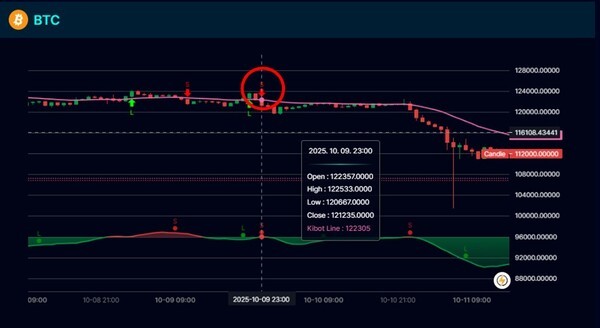
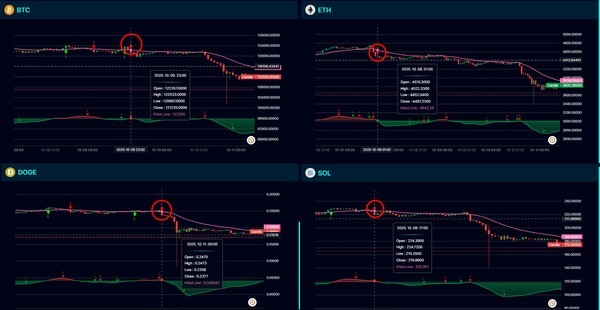
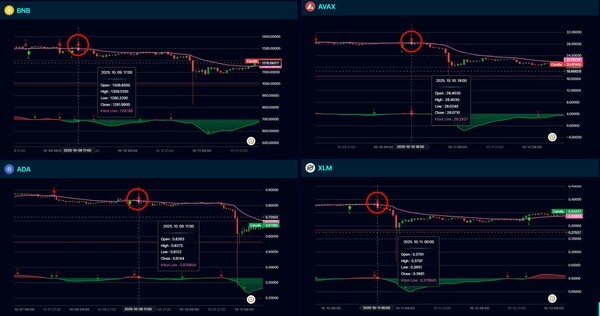
Thanks to these clear S signals, RisingX users avoided entering opposite L (Long) positions and instead proactively built S (Short) positions. This allowed them to generate substantial profits during the market crash. The episode served as a decisive example proving that RisingX’s signal accuracy directly translates into success in maximizing returns during periods of crisis.
While other AI systems were pushed to the edge of liquidation, RisingX successfully transformed the market “disaster” of a crash into an opportunity for explosive gains.
RisingX’s signals also performed reliably in XRP, where long-position liquidation rates were particularly high. After an S (Sell) signal was triggered on October 7, XRP fell by approximately 4.5%. On October 8, the price entered a brief consolidation phase accompanied by a deceptive rebound.
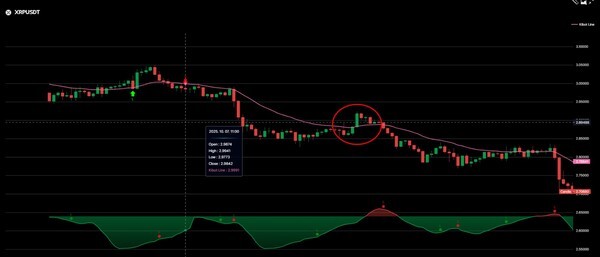
Many investors interpreted this as the end of the downtrend and re-entered L (Long) positions. However, RisingX’s algorithm did not recognize this rebound as a genuine trend reversal. As a result, no L signal was issued, preventing users from falling into false optimism.
The system identified this move as a fake rebound orchestrated by major market players to mislead retail investors, and therefore withheld any bullish signal. This allowed many users to maintain their short positions.
XRP subsequently plunged again, liquidating a large number of long positions. RisingX, on the other hand, continued to signal “not yet,” and that judgment ultimately protected users’ assets.
◆ The ‘Score Chart’ That Signaled Recovery and Changed the Game
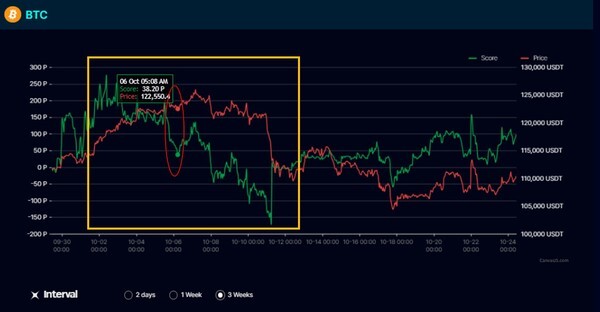
The RisingX Score Chart has been a core predictive indicator since the platform’s early development. By analyzing the relationship between the predictive Score line (green) and the actual Price line (red), the chart is designed to capture both mid- to long-term market direction and volatility.
As shown in the data, the predictive trend closely aligned with actual price movements, reinforcing the credibility of RisingX’s accumulated score data.
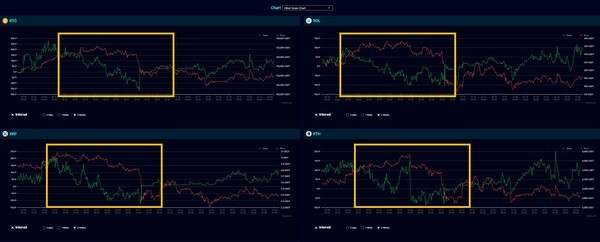
(Source: Actual RisingX Kibot Score Chart Image)
The green Score line represents the predictive trend, while the red Price line indicates the actual market price.
From October 6 to October 9, the gap between the predictive line and the actual price widened rapidly, indicating overheated market energy. Based on this signal, RisingX users refrained from entering long positions.
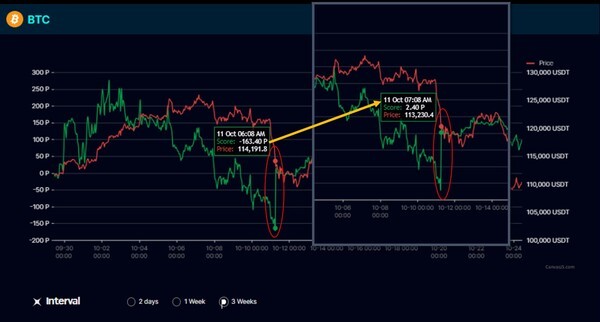
After the decline, the score value recovered sharply between 6:00 a.m. and 7:00 a.m., not only predicting the downturn but also signaling the precise zone where the decline would end.
Even as prices continued to fall, the Score Chart displayed early signs of a trend reversal. Around 6:00 a.m. on October 11, the score line rebounded sharply toward the price line, narrowing the gap significantly. Approximately one hour later, at 7:00 a.m., downward pressure was effectively neutralized.
This sequence demonstrated that the Score Chart went beyond merely predicting declines — it proactively identified the point where selling pressure would dissipate and recovery would begin. As a result, RisingX users were able to secure profits and prepare for their next entry at a critical decision point.
◆ Conclusion
This case clearly illustrates that success or failure in AI trading is not determined by prediction accuracy alone, but by the ability to avoid risk and identify the next opportunity.
While high-profile AI models such as ChatGPT and Gemini suffered near-liquidation losses due to leveraged multi-position strategies, RisingX combined deep-learning technology with exclusive whale-data insights to protect assets and turn crises into opportunities.
The future of AI investing is no longer about “humans versus AI,” but about how AI is used. By capturing market psychology and institutional behavior overlooked by other AI systems, RisingX has gone beyond being a simple prediction tool and has fully established itself as a true asset guardian for investors.
In the era of AI-driven trading, RisingX has proven itself to be the ultimate winner by setting a new standard for the most important principle of all: investing without losing.