[Blockchain A to Z] Entering the World of Cryptocurrency (Part 1)
By The VOB Foundation
Cryptocurrency is a digital, peer-to-peer asset built on blockchain technology that enables secure transactions without central authorities, using consensus mechanisms like PoW and PoS to maintain trust and integrity. Bitcoin, introduced in 2009, is best understood not as traditional money but as a unique digital asset and store of value that challenges existing financial systems through decentralization and cryptographic security.
Cryptocurrency is a digital asset used on the internet. It is a new form of money that enables direct peer-to-peer transactions without intervention from a central bank or financial institution.
Unlike traditional currencies, it is not printed at a mint, and unlike gold, it is not obtained by extracting a natural resource. Cryptocurrencies are created through complex computational processes, commonly referred to as “mining.”
How Cryptocurrency Is Created (Three Major Types of Mining/Consensus)
(1) PoW (Proof of Work)
Proof of Work is one of the oldest and most widely used consensus mechanisms. Participants use computers to solve difficult mathematical problems, and the first computer to find the correct solution earns the right to create a block and receive a reward.
This process requires enormous computing power and consumes significant energy. A 대표 example is Bitcoin (BTC).
(2) PoS (Proof of Stake)
Proof of Stake selects block producers based on the amount of cryptocurrency they hold and how long they have held it—i.e., their “stake”—instead of raw computing power. Because it does not require heavy computation, it is more energy-efficient and is often considered more environmentally friendly. Ethereum (ETH) is a 대표 example, and it transitioned to a PoS-based structure in 2022.
(3) DPoS (Delegated Proof of Stake)
Delegated Proof of Stake is an evolution of PoS in which participants vote to elect representatives who produce blocks and validate transactions. These elected delegates receive rewards and distribute them. The model can be fast and efficient, but it may also raise concerns about centralization because a small number of representatives control block production. Examples include Steem and EOS.
Cryptocurrency and the Principle of Blockchain
A blockchain is a distributed ledger system where everyone records and monitors the same history. To make the idea easier, imagine a game scenario.
Suppose five people are playing a card game with a special rule: everyone writes down the result of each round in their own notebook—who won points, who lost points, and what happened.
After each round, if someone says, “Minsu earned 3 points and Minji lost 2 points this round,” everyone records the same statement. Repeating this each round makes cheating difficult, because any altered record can be checked against others.
This is essentially how blockchain works.
Core Principle 1: Everyone Holds the Same Ledger (Distributed Ledger)
In a blockchain system, no single person or organization owns the ledger. All participants hold the same transaction history. To change data, an attacker would need to alter a majority of records simultaneously, which is practically impossible.
Core Principle 2: Records Are Verified Before Being Added (Proof of Work)
Records are not accepted just because they are “saved.” They must pass a verification process first. In PoW systems, participants perform computations to prove the validity of the record before it can be added to the blockchain as a block.
So, What Is a Blockchain?
A blockchain is not merely a data-storage technology—it is a system that structures “trust” for the digital era. Transactions are recorded simultaneously, participants monitor each other, and the system verifies itself without external intervention. As a result, it can enable transparent and secure transactions without a central authority.
Lecture 2: Why Is Bitcoin Special?
Bitcoin was first introduced to the world in 2009 by an unknown individual (or group) using the name “Satoshi Nakamoto.” At the time, trust in banks and governments was rapidly eroding due to the global financial crisis. Satoshi aimed to build a currency that could operate without a central institution—allowing direct transactions between individuals without a trusted third party. The result was Bitcoin.
A Computational Guessing Race: Proof of Work
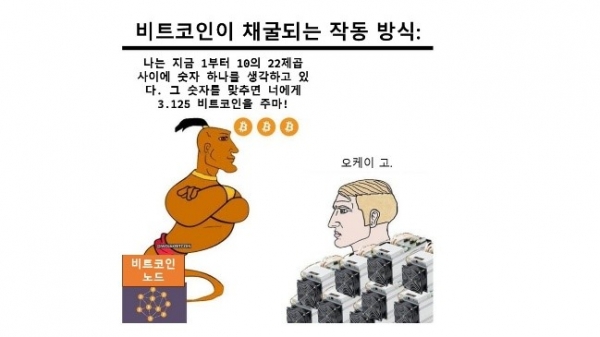
Bitcoin mining can be compared to a puzzle game. For example, imagine someone says, “I’m thinking of a number between 1 and 22 squared. If you guess it correctly, you’ll get a reward.” Computers then try random combinations until one finds the correct answer first—earning newly issued Bitcoin as the reward.
This structure is called Proof of Work (PoW). The computer that performs the successful computation wins, and as competition increases, stronger computing power becomes necessary.
Why Individual Mining Is Difficult
Bitcoin’s mining difficulty is designed to increase over time. As a result, mining computations become more complex, and mining with an ordinary personal computer is now nearly impossible.
Today, efficient mining typically requires specialized “mining factories” with hundreds of high-performance machines. While PoW raises concerns about energy consumption, it also plays a crucial role in maintaining network security.
Is Bitcoin “Money” or a “Digital Asset”?
One of the oldest debates around Bitcoin is whether it is truly a currency or merely an asset. A popular analogy compares Bitcoin to a platypus—an animal that is hard to categorize because it lays eggs like a reptile but is also a mammal, has a duck-like bill, lives in water, and even has venom.
Bitcoin is similar: it is called a “cryptocurrency,” but it has limitations as everyday money. It is not something you put in a physical wallet or use at a supermarket. It is traded digitally, and its price fluctuates like an investment asset—often making it feel more like a digital asset than a traditional currency. In some countries, it is categorized as an asset and subject to taxation.
So What Exactly Is Bitcoin?
Strictly speaking, Bitcoin is closer to a “digital asset” than a traditional currency: it is traded, its price changes in real time, and it is treated as an investment and trading instrument.
However, unlike traditional money, it is not controlled by a central bank, and it enables peer-to-peer transactions through blockchain technology—creating a fundamentally different structure from existing monetary systems.
In the end, Bitcoin is a new type of digital store of value that does not fit neatly into existing categories of assets or currencies. Like a platypus, it may be difficult to classify—but it undeniably exists and is reshaping the global financial system.




 Lecture 1: What Is Cryptocurrency (Crypto)?