[Blockchain A to Z] A Practical Cryptocurrency Guide: From Account Setup to Futures Trading
By The VOB Foundation
This guide walks beginners through the entire cryptocurrency trading journey, from creating an exchange account and securing it to using spot and futures trading on Binance. It explains key trading concepts, risks, and interfaces in a practical, step-by-step manner, making complex markets easier to understand. Finally, it introduces AI-driven trading tools like RisingX, showing how data-based signals can help traders reduce emotional decisions and trade more strategically.
The dynamic nature of the cryptocurrency market has captured the attention of domestic investors.
The strong upward momentum of Bitcoin (BTC) and Ethereum (ETH), along with the emergence of countless altcoins,
has led many to view cryptocurrencies as a new asset class.
It is now common to hear people say, “Maybe I should try crypto too.”
The author began trading out of the same curiosity—and continues to trade today.
The moment of first logging into an exchange, however, remains vivid.
It feels much like the first day at a gym after finally signing up—standing helplessly in front of unfamiliar machines
and complex workout routines.
The endless numbers, charts, and rapidly changing data on the trading screen can be overwhelming for beginners.
In this article, we will use the web interface of Binance—the world’s largest cryptocurrency exchange—as an example
to guide beginners step by step through the exchange environment they encounter for the first time and how to use it.
1. Account Creation and Security Setup
To begin investing in cryptocurrency, you must first create an exchange account.
The registration process is simple.
On the official Binance website, click the “Sign Up” button and enter either your email address or mobile number.
After setting a password and completing email verification, your account will be created.
Once the account is created, the next step is KYC verification (Know Your Customer).
This process requires you to submit personal information such as your name, date of birth,
a photo of your identification, and facial verification.
Only after completing KYC will trading and deposit/withdrawal functions be fully activated.
Setting up Two-Factor Authentication (2FA) is also essential.
Most users rely on the Google Authenticator (OTP) app.
This additional layer of security significantly reduces the risk of hacking or unauthorized access.
※ KYC verification and 2FA are essential measures to protect your assets.
2. Depositing Funds into Binance
Since Binance does not support direct KRW (Korean Won) deposits,
most investors purchase cryptocurrency (such as USDT) on a domestic exchange
and then transfer it to Binance.
The deposit process is as follows:
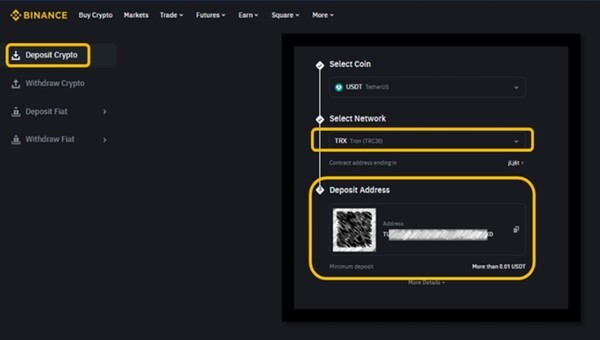
In Binance, navigate to [Deposit Crypto],
select the cryptocurrency you wish to deposit,
and choose the appropriate blockchain network
(for USDT transfers, select TRC20).
Copy the generated deposit address or QR code,
then initiate a withdrawal from your domestic exchange to that address.
One critical point to remember is network compatibility.
If you generate a TRC20 address on Binance,
you must also select TRC20 on the sending exchange.
A mismatch may result in permanent asset loss.
※ Using the wrong network can result in irreversible loss of funds.
3. Spot Trading Basics
Spot trading is the most suitable method for beginners and forms the foundation of cryptocurrency trading.
In spot trading, you purchase and actually own the cryptocurrency.
The purchased asset is stored in your wallet and can later be sold for profit when the price rises.
◇ Accessing the Trading Screen
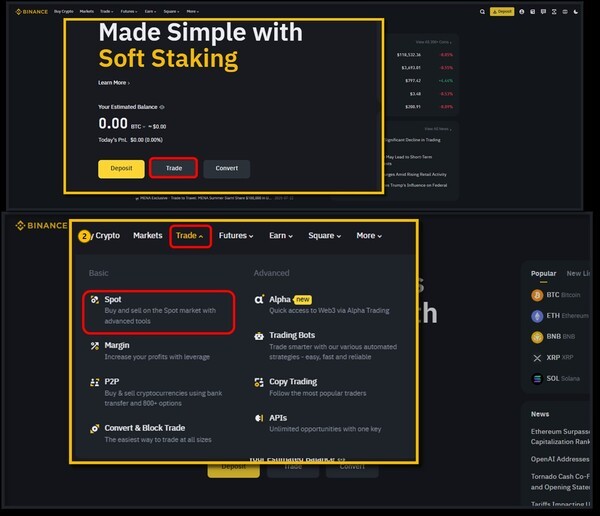
To start spot trading, click [Trade] → [Spot] from the top menu on Binance.
◇ Interface Overview
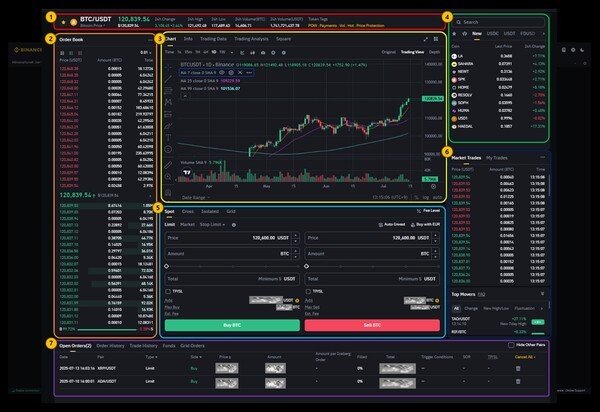
The spot trading interface consists of seven main sections:
1. Trading Pair Information: e.g., BTC/USDT
2. Order Book: Displays real-time buy and sell orders
3. Chart Area: Price trends, volume, and indicators
4. Market List: Search and compare different coins
5. Order Panel: Place buy or sell orders
6. Trade History: Real-time executed trades
7. Open Orders & Assets: Pending orders and completed trades
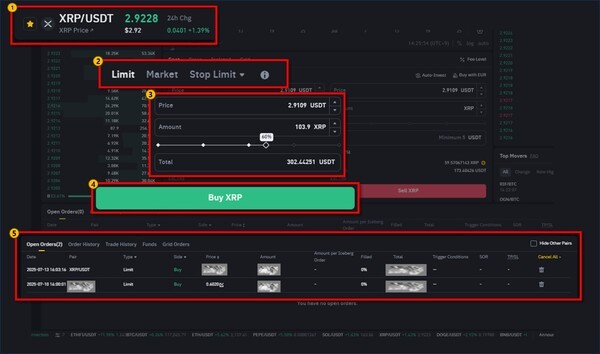
◇ Order Types
There are two primary order types:
Market Order: Executes immediately at the best available price
Limit Order: Executes only when the market reaches your specified price
Once an order is executed, the asset is automatically stored in your Spot Wallet.
You can view your total assets under the [Overview] menu.
4. Futures Trading Basics
Futures trading offers the potential for high returns,
but it also carries a high risk of liquidation.
This structure allows traders to use leverage,
enabling positions far larger than their initial capital.
◇ Structure and Risk
If your market direction prediction is incorrect,
your position may be liquidated,
resulting in the loss of your entire margin.
High leverage magnifies both profits and losses exponentially.
◇ Margin Modes
Binance provides two margin modes:
Cross Margin: Uses total account balance to prevent liquidation (high risk)
Isolated Margin: Limits losses to the margin allocated to that position
※ Beginners should always use Isolated Margin.
◇ Accessing Futures Trading
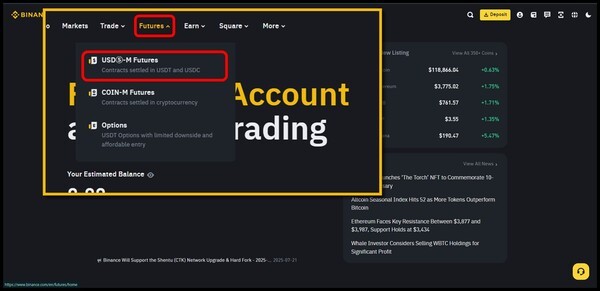
Navigate to [Futures] → [USDⓈ-M Futures] to access the futures trading interface.
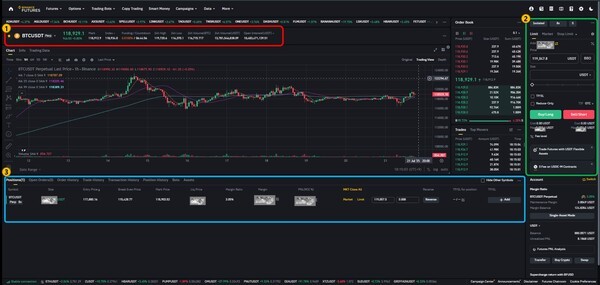
◇ Futures UI Overview
1. Instrument Info: Funding Rate, Mark Price
2. Order Panel: Leverage (1x–125x), TP/SL settings
3. Position Info: PnL, Liquidation Price, Margin Ratio
◇ Asset Review After Trading
Assets from futures trading are automatically transferred to the Futures Wallet.
You can view spot and futures balances together under [Overview].
5. From Features to Strategy
Once you understand the structure of spot and futures trading,
the next step is building your own strategy.
When to buy, and when to sell—this is the eternal question for every trader.
Professional traders invest enormous time and effort analyzing price movements,
volume, sentiment, and external factors.
But how much time and loss must a beginner endure to reach that level?
What if there were a system that could analyze the market in advance,
helping you respond without relying on guesswork?
What if simply following well-structured signals could generate returns?
◆ AI-Guided Cryptocurrency Trading
Now is the time to begin.
1. Everything Is Ready—The Next Step Is Profit
Once you’ve learned account creation, deposits, and trading mechanics,
the real challenge begins:
Which coin should you buy, and when should you sell?
Selling is always harder than buying.
Mistiming an exit can erase profits in seconds.
Trading requires strategy, discipline, and emotional control—elements most beginners struggle with.
2. What If AI Already Knows the Answer?
In 2025, it is hard to find students completing assignments without AI assistance.
AI is faster than search engines and more accurate than manual calculation.
The question is no longer “How can I do better?”
but “How can I work with AI?”
The cryptocurrency market is no different.
AI excels at analyzing massive datasets and tracking real-time volatility.
The key is how effectively you leverage decision-support technology.
3. RisingX – A Crypto AI Trained Over 8 Years
RisingX is an AI-powered trading signal platform built on eight years of accumulated cryptocurrency data.
It analyzes market flows and predicts price direction in real time.
This goes beyond simple charts.
The AI monitors fund movements across exchanges,
whale wallet activity,
and real-time order book changes—
all synthesized into actionable signals through proprietary algorithms.
Signals are simple:
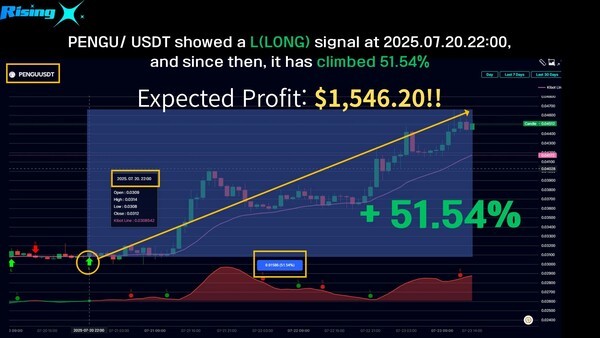
(L) Signal: Long position – expected price increase
After an L signal on PENGU/USDT at 22:00 on July 20, 2025,
the price increased by approximately 51.54%.
With $1,000 capital and 3x leverage,
this would result in a 154.62% return—$1,546.20 in profit.
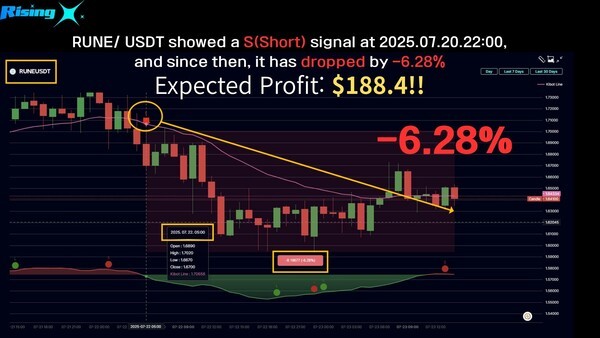
(S) Signal: Short position – expected price decline
RUNE/USDT dropped approximately 6.28% after an S signal at 05:00 on July 22, 2025.
With $1,000 and 3x leverage,
this would yield an $188.40 profit.
For more precise entry timing,
users can utilize the Kibot Line feature.
Entering near the pink guide line after a signal
is a beginner-friendly strategy for controlled risk.
4. Removing Emotion, Leaving Only Data
The greatest risk in trading is human emotion—
fear, greed, hesitation, and anxiety.
AI eliminates emotional bias and delivers pure signals.
RisingX maintains an average win rate of approximately 80%,
providing tangible results for many beginners.
5. Can You Trade Without AI?
Choosing to trade independently without AI is a valid path.
Learning through experience—wins and losses alike—has value.
But whenever your perspective changes,
RisingX will be there.
With real-time charts, predictive signals,
and structured strategies,
AI is the fastest way to enter the market with confidence.
◆ Conclusion
AI is no longer a technology of the future—it is already part of everyday life.
From search and translation to navigation and decision-making,
AI is becoming indispensable.
The greatest weakness of humans is emotion.
Fear, impatience, and unfounded confidence often lead to investment failure.
AI compensates for these flaws by focusing purely on data and trends.
In an era where judgment is difficult and strategy is essential,
you no longer have to predict alone.
With data, technology, and AI,
investing becomes a calculated decision—not a gamble.